Biography of the Artist - Elie Hazak
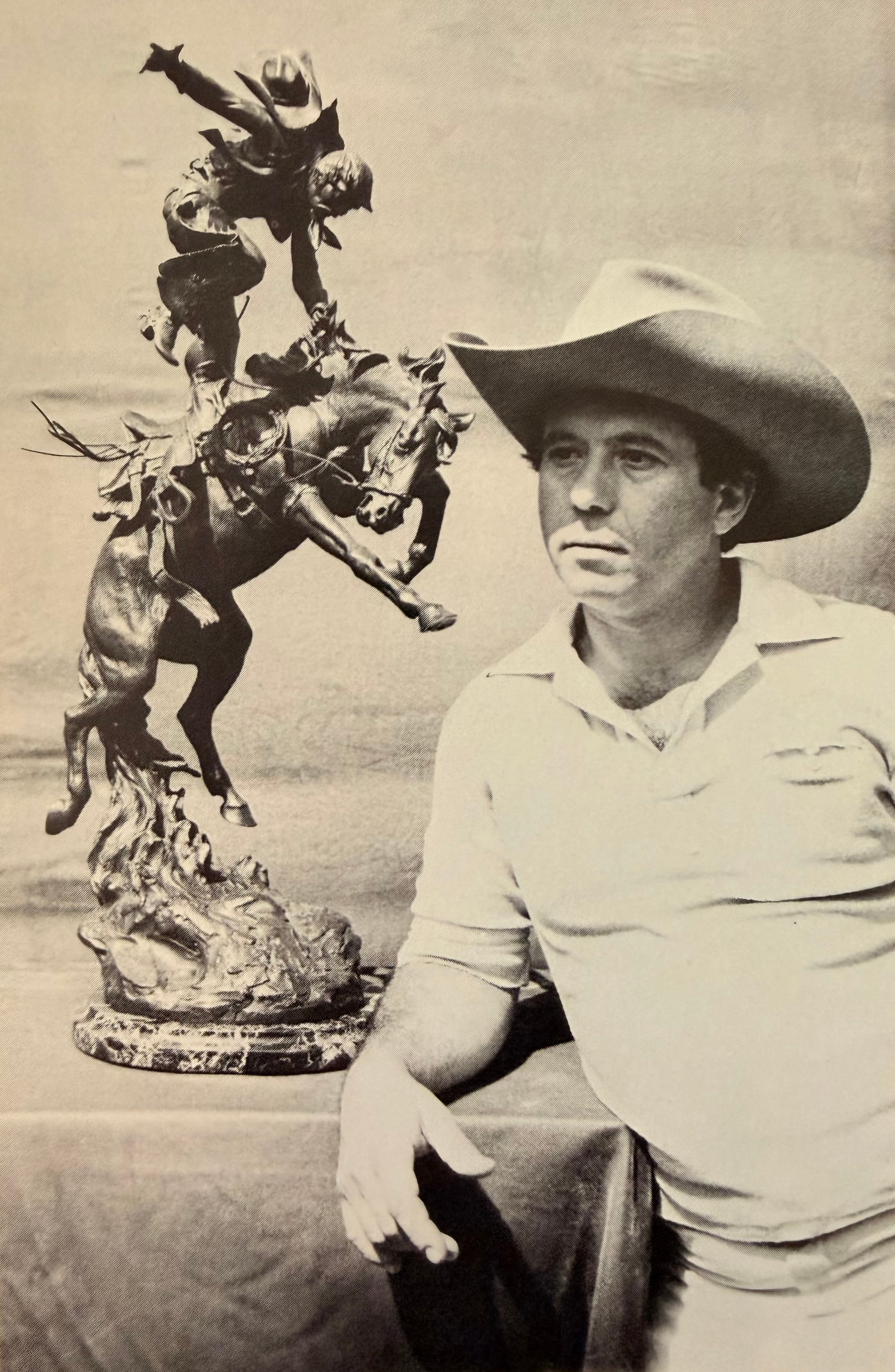
Elie Hazak is an unlikely looking Western artist. When you see his bronze sculptures depicting vivid scenes of Indians, cowboys, and mountain men, you imagine their creator to be the strong silent Gary Cooper-type. The kind whose mouth forms a perfectly straight line, opening only at the corner to say "yup" or "nope." The kind whose long, lean frame fits into a saddle as if he were born in it.
But Hazak, who works in a studio in his home, doesn't look like an Old West character. He prefers to wear shorts and a t-shirt rather than denims. After a serious riding accident, he prefers to sculpt horses, not sit on them. With his round jovial face and short stocky frame, he doesn't wear a cowboy hat as much as it wears him. And Hazak knows it. "Just call me the Jewish cowboy from Israel," he says with a laugh.
Elie feels his biggest gift is his imagination. "Bronze is cold metal," he says. "When you think of bronze, you think of cold and heaviness. I like to bring motion and put emotion into the faces of both men and animals. I like to give human feelings to animals." Hazak succeeds with his goal. His bronzes, some of which weigh up to 200 pounds, practically surge with life, capturing moments of dramatic intensity.
Why would an artist raised in Israel, halfway around the world from the United States, become so captivated with the Old West? As Hazak explained, the West is a state of mind that is universally appealing. "When you think about it, foreigners really created the West and then they came here to be in that picture," Hazak said. "The freedom, the horses-they existed, but it was the foreigner who romanticized it."
Hazak conjectured that Western art is such a popular form today because it "symbolizes the space and freedom we had at one time, and are losing every day." As a boy growing up in Jerusalem, Hazak was fascinated by art, and particularly by sculpture. He grew up near Mt. Zion in Jerusalem, the burial place of King David. As a teenager, he studied at the Bel Zallel Art School in Jerusalem. He later toured Israel and Europe as an actor and performer, working on clay sculptures in his spare time.
Hazak is one of the handful of living artists whose work is on permanent display at the Thomas Gilcrease Museum in Tulsa, Oklahoma, the foremost showcase of Western art in the United States.
By Nikki Batalis, Ventura Star Free Press